
How to run a charity golf scramble: a step-by-step guide

A scramble is the format most charity golf tournaments use, and for good reason. Four players tee off, the team picks the best shot, and everyone plays from there. A golfer who hits it sideways still helps the team, and a golfer who has never been on a course still gets a shot in. That keeps the day friendly, and it keeps play moving.
The hard part isn’t the golf. It’s everything around it: pricing, registration, sponsors, volunteers, the raffle and getting the day to run on time. This guide shows how to run a charity golf scramble from the first meeting to the thank-you emails, with the rules, the handicap maths and a real day-of timeline.
The short version
- To run a charity golf scramble, book the course and set the date first. Most organizers start 4 to 6 months out.
- Price the day from your costs, then work out what each golfer should contribute. Here’s how to set your golf tournament entry fee.
- Decide gross or net before you announce. A net scramble needs a team handicap, and that takes five minutes to work out.
- Volunteers make the day. Software can take the paperwork off them. It can’t hand out the beverage cart tickets.
How a golf scramble works
Here are the rules in plain words.
Every player on the team tees off on every hole. The team picks the best tee shot, and the three players whose shots weren’t chosen pick up their balls and move to within a club length of the chosen spot, no closer to the hole. Then every player hits from that spot. The team keeps picking the best shot until the ball is holed, and one score goes on the card.
Some committees add a rule that each player’s tee shot must be used a minimum number of times, so the best golfer doesn’t carry every hole. If you want that, write it on the rules sheet. Players will read it at check-in, so keep it short.
You’ll hear other names for similar formats, such as Florida scramble and Texas scramble. The differences are small, such as which shot you can pick or how many mulligans you get. Choose one, put your charity golf scramble rules on one page, and hand it to every team. If you want every player to play their own ball instead, see how to run a best ball golf tournament.

Gross or net? How to handicap a scramble
You have two choices, and both are fine.
Gross scramble
- Easiest to run. The team’s score is the team’s score, with no maths before or after.
- Best for a social day where prizes matter less than the fun.
- Less fair when teams vary a lot. A team with two low handicaps will usually beat everyone.
Net scramble
- Levels the field. Each team gets a team handicap, and you subtract it from the gross score.
- Best when there are real prizes and a mix of strong and casual teams.
- Needs every player’s handicap at registration, so ask for it on the form.
For a four-person scramble, the USGA’s recommended allowances, widely used in club and charity events, are 25%, 20%, 15% and 10% of each player’s course handicap, from the lowest handicap to the highest. Add the four results and round to the nearest whole number.
A worked example, for a team with course handicaps of 4, 9, 14 and 22:
| Player | Course handicap | Allowance | Result |
|---|---|---|---|
| A (lowest) | 4 | 25% | 1.0 |
| B | 9 | 20% | 1.8 |
| C | 14 | 15% | 2.1 |
| D (highest) | 22 | 10% | 2.2 |
| Team handicap | 7.1, so 7 |
If that team shoots 62 gross, its net score is 62 minus 7, which is 55. The scramble isn’t part of the official Rules of Golf, so these percentages are a recommendation, not a requirement. Say which method you’re using on your rules sheet.
Key takeaway: Pick gross or net before you announce, and put the method on the rules sheet. For net, collect every player’s handicap at registration.
How to run a charity golf scramble: the 9 steps
Here’s how to run a charity golf scramble in nine steps, in the order that saves the most trouble.
Key takeaway: Steps 1 to 3 (budget, course, price) come before you announce anything. Everything else gets easier once those are fixed.
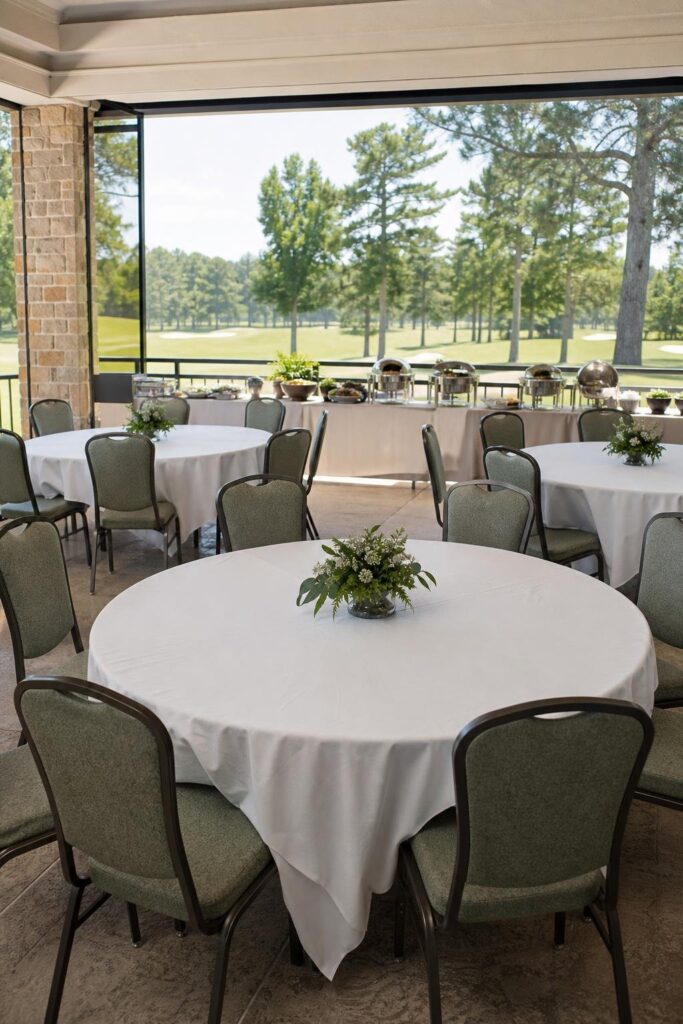
Your event-day timeline
A shotgun start keeps the day tidy, and a clear golf scramble timeline keeps volunteers calm. Everyone tees off at once, so everyone finishes at about the same time, and the meal and awards follow. Here’s a typical schedule for an all-day scramble. Move it earlier or later to fit your course.
| Time | What’s happening |
|---|---|
| 7:30 | Volunteers arrive and set up: registration table, signage, contest holes |
| 8:00 | Check-in opens, breakfast and range balls |
| 8:45 | Welcome, rules, safety and a photo of each team |
| 9:00 | Shotgun start |
| about 1:30 | Round ends, scores go to the scoring table |
| 1:30 to 3:00 | Lunch, awards, raffle and 50/50 draws, thank-yous |
Plan on the round taking about 4.5 hours with a full field in carts, and on the whole day running 5 to 7 hours from check-in to awards. A slow first hole makes everyone late, so station a marshal there.
At check-in, a printed list turns into a queue fast: someone hunts for a name, ticks it, and chats while the line grows. Organizers who’ve run events on TourneyCommand told us that a QR scan at the door cut the wait and left more time to talk to golfers, which matters, because the conversation is where donations and raffle tickets happen.
Volunteer roles that keep a scramble moving
Think of these as a starting point, and scale them to your field size.
- Registration table (2 people). Check teams in, hand out the rules sheet and any cart cards.
- Contest holes (1 per hole). A volunteer at closest-to-the-pin and longest-drive holes records the winner.
- Marshal at the first tee or hole 1. Keeps the shotgun on time.
- Raffle and 50/50 sellers (2 people). They mingle on the course and at the meal. Volunteers make the day: the platform handles the paperwork so they can spend it with people.
- Photographer and a runner. One to capture team and sponsor photos, one to fix anything small.
Raffles, 50/50 and your licence
A raffle or 50/50 draw can double what a tournament raises, and it’s regulated. In Ontario, a 50/50 draw is a raffle, and a charity needs a lottery licence before it sells a ticket. Municipalities license many paper raffles, and the AGCO licenses electronic raffles. Apply early, and read the AGCO’s raffle rules. Rules differ by province, so check yours. This is general information, not legal advice.
Software can run the draw, but the licence is the organizer’s job.
Five mistakes first-time organizers make when they run a golf scramble
1. Setting the price last. Fix the entry fee before you announce anything, because changing it later is awkward. If you are giving tax receipts, the free fee and receipt calculator checks the fee against the CRA’s 80% rule first. 2. Forgetting handicaps. If you’re running net, collect them at registration, not at the first tee. 3. Leaving sponsors until the end. Sponsors decide on the strength of a real event page, so build it first. 4. No written rules sheet. One page of rules saves a dozen arguments. 5. Running check-in off a printed list. It’s slow, and it hides the best part of the day: the first conversation with each golfer.
I’ve been the organizer with the spreadsheet and the golfer at registration wondering whether anyone knew they’d paid. A lot of this comes down to taking the chasing away, so you can spend the day talking to people.
Where TourneyCommand fits
If you want to run a charity golf scramble without the spreadsheet, TourneyCommand takes care of the registration side of all this: your own event site, sign-up for teams and sponsors, QR check-in, raffles and 50/50 draws, and your money going straight to your own accounts. See the flat pricing, try the live demo, or read the FAQ. If you’re still choosing a platform, here’s what golf tournament registration software really costs.
Timelines and entry-fee ranges are typical figures. Adjust them for your course, your field size and your cause.
READY WHEN YOU ARE
Run your scramble without the spreadsheet
Registration, sponsor sign-up and QR check-in on your own event site, live in under 15 minutes. Your golfers’ money goes straight to your own account.